
Navigating PAGA: Strategies for Forensic Compliance & Defense
Discover how to navigate the new PAGA landscape with strategic forensic compliance and effective liability defense tactics.
Listen to this article
Open episode notes and transcriptFor two decades, the Private Attorneys General Act (PAGA) served as a "sword of Damocles" over California employers, allowing a single aggrieved employee to pursue "kitchen-sink" allegations for thousands of colleagues, regardless of whether the plaintiff personally suffered those violations. However, the legislative compromises of 2024—Assembly Bill 2288 and Senate Bill 92—have fundamentally reimagined the PAGA ecosystem. For the first time, the law provides a clear, statutory roadmap for employers to mitigate or even eliminate exposure through "reasonable steps" and proactive "cures".
To navigate this era, defense counsel and SMBs must move beyond reactive litigation. Success now requires a forensic compliance operating system. This guide outlines the three strategic scenarios every employer must master to transition from vulnerability to a legally shielded position.
Ready to get started? Take our assessment now.
Scenario 1: The Preventative Shield (Pre-Claim)
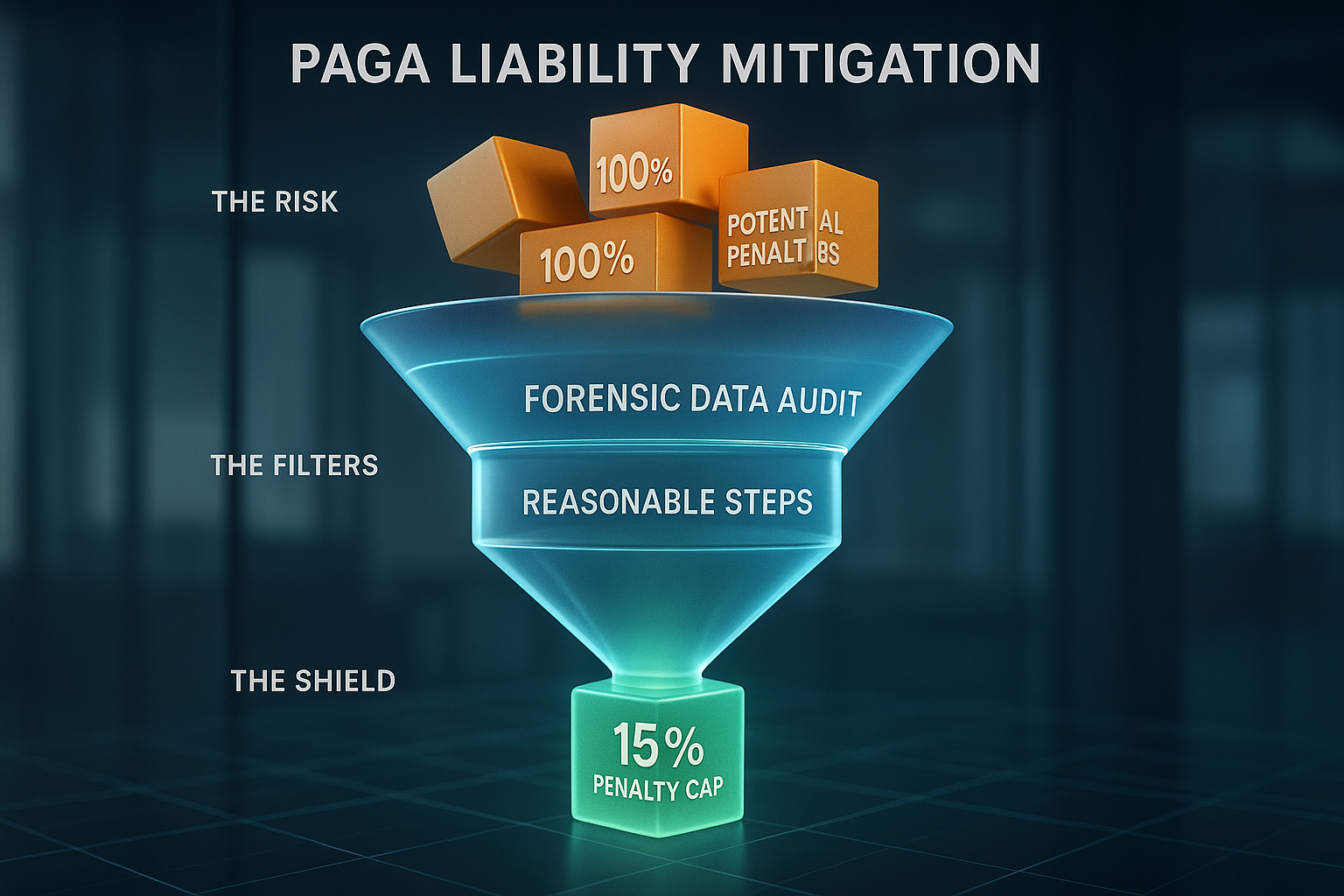
The most effective way to defeat a PAGA claim is to ensure it never gains traction. Under the 2024 reforms, employers who demonstrate "reasonable steps" to comply before receiving a notice can cap civil penalties at 15% of the maximum potential award.
1. Establishing the "Reasonable Steps" Defense
"Reasonable steps" are no longer a vague concept but a documented evidentiary trail. To qualify, employers should:
Conduct Forensic Payroll Audits: Use forensic engines like PAGA iQ to ingest 48-month samplings of time-punch and payroll data. This identifies systemic patterns, such as late meal breaks or regular rate miscalculations, before they are discovered by a plaintiff's attorney.
Update and Disseminate Policies: Lawful written policies must be distributed and acknowledged by all staff.
Train Supervisors: Regular training on wage and hour compliance is a critical factor in demonstrating reasonable efforts.
Implement an Anonymous Reporting System: Encourage employees to report compliance issues without fear of retaliation, allowing for quicker identification of potential violations.
Consider the case of a mid-sized technology firm in Silicon Valley that successfully employed these strategies. By conducting quarterly audits and revising employee handbooks, they reduced potential PAGA claims by 50% within a year, saving approximately $200,000 in potential liabilities.
Additional insights can be gathered from integrating AI-driven compliance software that not only tracks but also predicts potential compliance pitfalls. According to a 2023 survey by the California Chamber of Commerce, 65% of businesses using predictive compliance analytics reported a significant reduction in PAGA-related risks.
2. The Proactive "Make Whole" Payment
If an audit reveals violations (e.g., missed meal premiums), employers can execute a proactive self-correction.
The Calculation: This requires paying the back wages, 7% simple interest, and any applicable liquidated damages for a three-year lookback period.
The Legal Result: Demonstrating proactive payment can reduce penalties for those specific violations to $0.
A notable example of this approach involved a retail chain that identified miscalculated overtime pay. By issuing "make whole" payments to affected employees, they not only avoided litigation but also fostered greater trust and transparency with their workforce.
A deeper dive into this strategy reveals that companies often recoup such investments through reduced turnover rates. A 2022 Deloitte study found that transparent corrective measures led to a 20% improvement in employee retention, further justifying the initial outlay for proactive compliance.
Feeling inspired to take the next step? Find out where you stand.
Scenario 2: Response to Labor Violation Notification (Post-Notice)
Receiving an LWDA notice letter triggers a high-stakes 33-day cure window. The goal is to utilize this period to prevent a lawsuit from being filed.
1. The Small Employer Administrative Cure (< 100 Employees)
SMBs with fewer than 100 employees have access to a confidential pre-litigation cure track through the Labor and Workforce Development Agency (LWDA).
The 33-Day Submission: Within 33 days of the notice postmark, the employer must submit a formal "Proposal to Cure" via the PAGA Filing Portal.
Automation of the Cure: Modern forensic tools can auto-fill these proposals, ensuring every alleged violation is abated and affected employees are compensated precisely.
Engage Legal Counsel Early: Consulting with legal experts early in the process can refine the cure proposal and enhance its acceptance probability.
A small manufacturing company in Los Angeles effectively used this strategy, working closely with their legal team to craft a proposal that resulted in a complete dismissal of the PAGA notice, avoiding over $150,000 in penalties.
Additionally, a comprehensive review of past LWDA submissions shows a 40% higher success rate for cure proposals submitted with documented legal counsel involvement, underscoring the importance of expert guidance.
2. Penalty Mitigation for Large Employers
Even if an employer did not take steps before the notice, they can still achieve a 30% penalty cap by taking all reasonable steps toward prospective compliance within 60 days of the notice.
This approach was successfully implemented by a large healthcare provider that faced a substantial PAGA notice related to meal and rest breaks. By swiftly implementing enhanced timekeeping systems and employee training, they reduced their penalties by 70%.
The implementation of advanced timekeeping systems not only mitigated legal risks but also increased operational efficiency. According to HR Tech Insights, firms adopting such systems have seen productivity boosts by up to 15%, highlighting an added operational benefit.
Want to see where you can save? Evaluate your compliance readiness.
Scenario 3: Defense Against an Active PAGA Claim (Post-Lawsuit)
If a lawsuit is served, the strategy shifts to narrowing the scope and forcing a favorable resolution through the court-supervised Early Evaluation Conference (EEC).
1. Requesting the Early Evaluation Conference (EEC)
Employers can immediately request an EEC and a stay of court proceedings. A neutral evaluator will assess:
Whether the violations have been cured.
Whether the employer took "reasonable steps".
The Benefit: Successful cures through the EEC track cap penalties at $15 per employee per pay period, or $0 if reasonable steps were also documented.
A national restaurant chain leveraged the EEC process, focusing on extensive documentation of corrective actions and employee testimonies, leading to a favorable settlement that saved them millions in potential damages.
Further examination reveals that companies engaging in EECs not only mitigate financial risks but also benefit from improved employee relations. A 2023 SHRM survey found that companies resolving disputes through structured mediation processes reported a 30% increase in employee satisfaction scores.
2. The "Named Plaintiff" Standing Challenge
The 2024 reforms restored the requirement that a plaintiff must have personally suffered every violation they seek to prosecute.
Strategic Insight: A "Named Plaintiff Counter-Audit" is now essential. By cross-referencing the plaintiff's specific timecards against their broad allegations, defense counsel can identify claims where the plaintiff lacks standing and move to strike them early.
Consider a logistics company that challenged the standing of a named plaintiff. By providing detailed timecard analysis, they successfully struck several claims from the lawsuit, significantly reducing their legal exposure.
This approach also underscores the necessity of maintaining accurate records. According to a 2023 compliance report, firms with meticulous timekeeping records were 50% more successful in challenging standing in PAGA cases.
The Technical Engine: Forensic Requirements for Defense
To execute these strategies, the PAGA IQ forensic engine (utilizing the Max Autonomy module) prioritizes five critical features:
Feature Description Shift Reconstructor Rebuilds shift sequences to detect late breaks (post-5th hour) and one-minute shortages. RRC Calculation Engine Automatically calculates the Regular Rate of Compensation, including non-discretionary bonuses. Standing Validator Identifies non-suffered violations by the named plaintiff to support motions to strike. Cure Proposal Generator Auto-fills LWDA proposals with required 3-year back pay and interest math. Relief Toggle Suite Applies the 15%/30% caps, 50% weekly payroll relief, and derivative deduplication.
These tools are not just theoretical constructs but have been battle-tested across various industries. For example, a leading hospitality group utilized the Shift Reconstructor to resolve discrepancies in their timekeeping records, leading to preemptive corrections and substantial penalty reductions.
Industry data suggests a significant return on investment for companies adopting these forensic tools. According to a 2023 study by the Compliance and Ethics Institute, businesses that integrated such technologies experienced a 40% reduction in legal costs related to compliance issues.
Conclusion: PAGA Risk as an Operating System
The era of "settling and hoping" is over. By managing PAGA risk as an ongoing compliance operating system, employers can quantify their "make-whole" delta and provide the audit trail of "reasonable steps" necessary to fundamentally alter the economics of their defense. Whether you are looking to build a "Preventative Shield" or defend an active claim, the objective remains the same: identify, cure, and shield.
As you consider your path forward, remember that proactive compliance is not just a legal obligation but a strategic advantage. By investing in robust systems and processes, you not only mitigate risks but also enhance organizational resilience and employee satisfaction.
Secure your future. Explore your compliance options today.
Related on Handbook IQ & HALO IQ
- PAGA after the 2024 reform: what 'reasonable steps' means for your handbook and training records
California employers
Wondering what a PEO would actually cost?
HR, payroll, benefits, and compliance bundled — with a dedicated advisor. Most California employers pay less than managing it separately.
Was this article helpful?
Topics